
A term often used in discussions to improve supply chain performance is ‘balancing demand and supply.’ But what does that mean in real-world, practical applications?
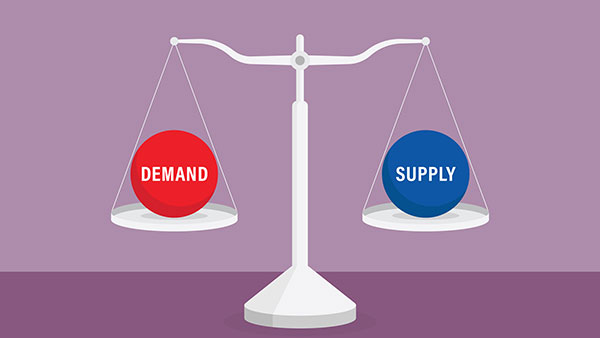
In short, balancing demand and supply means doing what it takes to have demand = supply. In a perfect world there is a demand plan (expressed as units shipped for a given item or SKU on a given day/week/month). A supply plan is generated to match the demand plan; the work is ensuring materials, production and distribution plans are sufficient to match demand plan.

Good supply chain planning balances demand and supply in an efficient cost-to-serve manner. Conversely, poor planning leads to operational heroics to meet orders. These heroics are likely familiar to planners because they manifest as overtime, changeovers/poor OEE, expedited transportation, increased inventory and lead to poor bottom-line results for the enterprise.
Even if perfectly planned (and avoiding the aforementioned operational heroics to meet incoming orders), a balanced plan can be elusive especially at a SKU/item/part level. Varying lead times and production resource capacities can create gaps. Broadly, there are two scenarios a planner needs to work through when demand is not equal to supply:
- Demand is greater than supply. Safety inventory is typically the first buffer to close gaps when the demand plan is greater than supply (and by definition, safety stock exists to be used—if it’s not being used at any point, then safety levels are too high…) If safety inventory is insufficient, then the work to rebalance would include (1) checking ability to transfer inventory within the network, (2) to produce more, (3) to substitute an acceptable equivalent product (e.g. same UPC), (4) to check the possibility of shifting demand to similar products available or that can be produced (e.g. different size or different flavor/scent) or (5) if demand is being stimulated by marketing/promotions, look to adjust (delay or refocus to available products.
- Demand is less than supply. In this case, the work to rebalance is either (1) reduce supply—cut or delay production or deployments or (2) stimulate demand—work with sales/marketing, especially if production has short or finite shelf-life and would lead to scrapping or sales at significantly reduced realization.
Why is balancing demand and supply important? While a demand/supply imbalance may be seen first at a supply planning level, it’s actually a true multi-functional business challenge. Financial plans typically tie to demand outlook. Implications of demand being unequal to supply can hit financial top and bottom lines. It’s intuitive to correlate lower demand with poorer financial outcomes. But if the gap is supply related, the impact can also be lower revenue (top line) and profit (bottom line.) For example, marketing spend is typically justified by an expectation to generate a specific demand amount. With supply insufficient to demand; companies could spend marketing dollars without achieving the incremental sales goal, impacting profit. Similarly, if demand is insufficient vs. supply plans, financial risks include product scrapping or lower realization that can negatively impact financials. But risks are not limited to immediate financial impact; supply being less than demand can create customer ill-will, imperiling future business opportunities, for example customer support of new product introductions in future.
Related:
What It Really Means: Bringing the outside in
What it really means: Democratizing the data
What it really means: Supply chain control towers
Benefits to balancing demand and supply: Competing in the market is hard, so it’s important to give your company the best chance of succeeding, which includes avoiding under or over supply vs. expected sales. The benefits of a balanced demand and supply plan show up in areas like:
- increased sales revenue and profit
- reduced expediting
- increased operational stability
- increased marketing and promotion ROI
- reduced short term plan changes (up or down)
- reduced sales at lower realization (discounting)
- reduced scrapping
Watchouts: Unfortunately, there can be many intended or unintended barriers to balancing demand and supply, including:
having a ‘one-size-fits-all’ solution when demand outstrips supply or supply outstrips demand. Companies should use portfolio segmentation to determine strategies and thresholds by product/customer to guide actions (e.g. some products require service at 100%, others may not merit the additional expense of meeting every unit of demand).
- lack of multi-functional collaboration, especially communications about activity to stimulate demand not yet reflected in plans
- insufficient attention to plan quality beyond short-term (unintentionally consuming lead times that may be needed)
- not planning using demonstrated capabilities (can create insufficient supply)
- not having inventory to absorb normal short-term variation (timing or product mix)
How to balance demand and supply?
The good news: the best method to balance demand and supply is not new. This method is strong multi-functional collaboration in the sales & operations planning cycle (S&OP). A healthy S&OP includes using marketing and sales inputs to help create high-quality demand plans, and using the demand plan to generate a matching supply plan based upon demonstrated capabilities (capacities, production rates, lead-times, etc.) and an inventory plan that can absorb short-term variability (e.g. timing of demand from week to week or shifts across product lines).
About the authors
Andrew Byer is a former P&G Supply Chain Leader. Mike Dobslaw leads EY’s Supply Chain Planning Practice. To learn more about how EY and P&G team to support supply chain transformations please write [email protected]
SC
MR

More Supply And Demand
 Explore
Topics
Business Management News
- Innovators Netstock, Pickle Robot win NextGen Solution Provider awards
- Bigger trucks versus broken bridges and roads
- From salon to dock door: Repurposing scheduling software for inbound flow
- The biggest barrier to AI in supply chains isn’t technology
- Rebuilding a planning function around the physical world
- Why companies blame the wrong supplier … and miss the real failure
- More Business Management
Latest Business Management Resources

Subscribe

Supply Chain Management Review delivers the best industry content.

Editors’ Picks



